I run a custom plush factory in Shenzhen, and a depressing share of my inbound emails start with the same sentence: "Hey, we used a factory in Yiwu / Guangzhou / Vietnam, and the bulk run came back nothing like the sample." By the time someone is emailing CozyPuff after that, they've usually already wired tens of thousands of dollars and have a warehouse full of plush they can't ship.
The choice of manufacturer is the single biggest decision in a custom plush project — bigger than fabric, bigger than design, bigger than freight terms. This guide is the checklist I'd hand a friend who was about to pick one for the first time. It's skewed toward the buyer's side, even though I'm on the factory side, because a buyer with a sharper checklist also makes my life easier: the projects that come in pre-screened are the ones that ship cleanly.
Why vetting your manufacturer is the entire game
A custom plush isn't a t-shirt. There's no standard pattern, no off-the-shelf SKU, and no QA report from a previous run to copy. Every plush is engineered from scratch off your sketch, and small process decisions — seam allowance choice, stuffing density, eye-attachment torque — compound through 3,000+ units. Get the factory wrong and a single bad decision is multiplied across your entire order.
The buyers who get burnt almost always made the same three mistakes:
- They chose on price alone. The lowest quote is almost always either a trading company sub-contracting to whoever's cheapest that month, or a real factory using lower-grade fabric than they quoted.
- They skipped the paid sample. A "free sample" from a $100 mascot project is almost never the same factory or pattern-maker as the bulk run.
- They didn't check certificates against the actual lab. A PDF of an EN71 report is easy to forge; a phone call to SGS takes 30 seconds.
Green flags vs. red flags at a glance
Before you get into the 14 detailed questions in the next section, here's the short version. If your candidate factory hits 4+ green flags and 0 red flags, they're worth a paid sample. If they hit a single red flag, walk away — you'll find another factory in 48 hours.
| Signal | Green flag | Red flag |
|---|---|---|
| Factory tour | Says yes immediately; offers live video walk-through if you can't fly out | Refuses video; only sends pre-recorded clips or stock photos |
| Address | Names a specific industrial park, building, floor; matches address on incorporation docs | Vague ("Shenzhen, China"), or address that turns out to be a residential or trading-park unit |
| Lead time quote | Gives a range with rationale (e.g. "7-8 weeks: 2 sample + 5 bulk + freight") | Promises 3 weeks no matter what you ask |
| Sample fee | Charges $80-$250 per sample, deducts from bulk PO | Free sample, no questions; or refuses sample altogether |
| Certificates | Sends full test report PDF naming SGS / Intertek / BV / TÜV + report number | Sends only a one-page certificate image, can't or won't share the underlying report |
| Communication | Replies in working hours, ~24h max; one POC stays consistent | POC changes between emails; major gaps in response time, then aggressive pressure to pay |
| Payment terms | 30% deposit / 70% before shipping, via bank TT or Alibaba Trade Assurance | Demands 100% upfront, or asks for personal bank account / unfamiliar payment processor |
| MOQ | 100-500 units for retail-grade custom plush, scales pricing at each break | "MOQ 10, we can do anything" — almost always a trader |
| References | Names 2-3 brands they've worked with; lets you contact one of them | Won't share any reference, citing 'NDAs' (real NDAs cover artwork, not vendor name) |
14 questions to ask on the first call
Send the same 14 to every factory you're considering. The answers are less important than the speed and confidence of the response — a real factory POC has answered these hundreds of times.
- How many years has the workshop been at its current address? Tells you whether they own the building or are a subletter who could disappear.
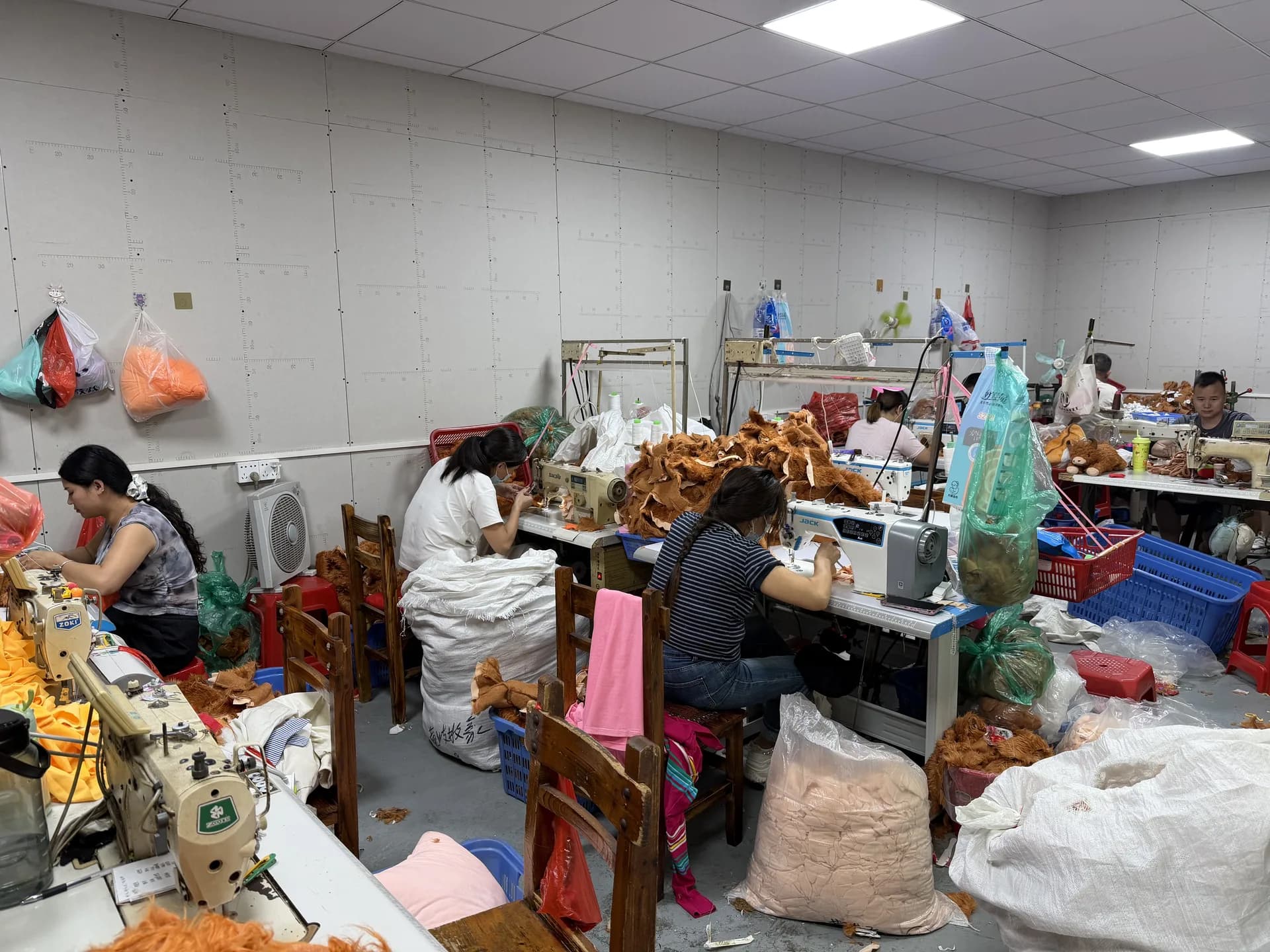
- How many people are on the sewing floor right now? Real number, not a marketing "100+". Real factories give you a real headcount.
- What's your typical MOQ and how does pricing scale? Should be a 100-500 entry, with explicit break-points at 500 / 1k / 3k / 5k / 10k.
- What's the sample fee and is it deducted from the bulk PO? Real fee, deducted = green flag.
- Which fabric mills do you buy from? A real factory names 2-3 mills by city and can talk about dye-lot consistency. A trader can't.
- Can I have the SGS / Intertek report number for your most recent EN71-1 test? Then you call the lab and verify.
- Who's my POC, and what time zone? Should be one person, who stays the same for the next 8 weeks.
- What's your QC process — in-line, pre-stuffing, final, or all three? Real factories do all three. Traders "just visually inspect".
- How is stuffing density controlled? Answer should mention weight per unit (e.g. "each cleared on a 0.1g scale to ±5g of sample weight").
- What happens if a bulk unit fails QC — rework or scrap? Rework is OK; secret-rework-and-ship-anyway is a red flag.
- What's your defect rate on the last 5 orders? Real factories say 1-3%. "Zero defects" is a lie.
- What shipping terms do you offer? Should be at least FOB + DAP/DDP; explicitly familiar with Incoterms 2020.
- Do you sign a mutual NDA, and a no-resale clause on the pattern? Both should be a yes without pushback.
- Can I visit, and if so, what's your fastest opening? A factory that volunteers a date this month wins.
The sample test that catches 80% of bad factories
Pay for a sample. Always. Yes, even the $200 it costs you. Reasons:
- Free samples often come from a different factory than the one you'll bulk with — they're marketing collateral, not your actual pattern.
- The cost of a sample concentrates the factory's attention. The same pattern-maker who handles your sample will handle your bulk.
- The act of paying creates a paper trail (invoice, payment reference) that protects you in disputes later.
When the sample arrives, run this 9-point test before you say a word about whether you like it:
- Is it within ±5% of the size you specified?
- Are the seams clean — no visible thread tails, no bunching, no exposed stuffing?
- Pull-test on each accessory (eyes, nose, tags): can you pull a hard 70N for 10 seconds without anything coming loose? This is the threshold in EN71-1 § 8.4.
- Squeeze the body: does the stuffing return to shape immediately, or does it stay dented?
- Smell test: any chemical or solvent smell means cheap stuffing or poorly washed fabric — both red flags.
- Check inside via the stuffing slot: is it cleanly serged or is there a raw cut edge?
- Snip a 5mm fiber from an inside seam. Does it shed badly when you rub it?
- Photograph the sample under daylight, then under indoor LED. Two-tone fabric shifting across light sources is normal; a complete color change isn't.
- Drop test: drop the sample from 1.5m onto a tile floor 10 times. Anything fall off?
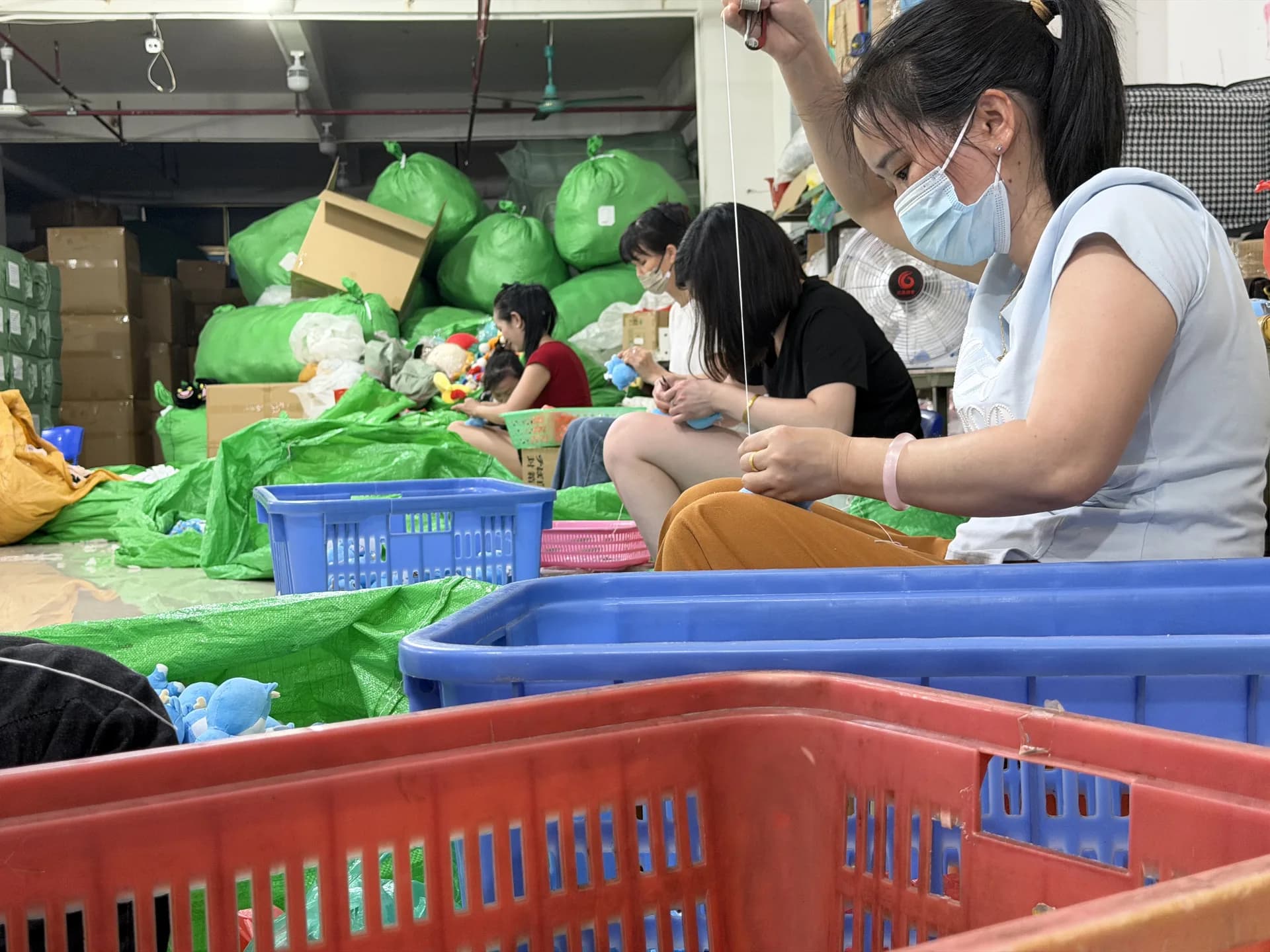
What 5,000 units actually costs — a factory's POV
Most quotes you get are a black box: "$3.80 each, all-in." Useful, but it makes it impossible to know what you're trading off. Here's how I'd break down a typical 5,000-unit 20cm mascot plush in PV velour with embroidered face and a hangtag, FOB Shenzhen, in 2026 prices.
| Line item | Per-unit cost | % of total | What changes it |
|---|---|---|---|
| Fabric (PV velour, 1 color) | $0.38 | 10% | Switch to faux fur → $0.90 (2.4×) |
| Stuffing (recycled PET fiber) | $0.22 | 6% | Switch to virgin PET → +$0.05; weight-pellets in feet → +$0.10 |
| Cutting + pattern labor | $0.18 | 5% | More pieces = more labor; rough threshold is 12 pieces |
| Sewing labor (hand + machine) | $0.95 | 25% | Complex face / extra limbs / accessory pockets — each +$0.10-0.25 |
| Embroidery (face + tag) | $0.42 | 11% | Higher stitch count = linear cost. 5,000 stitches ≈ $0.30; 12,000 ≈ $0.65 |
| Hangtag + woven label | $0.12 | 3% | Custom shaped tag / multi-color woven label → +$0.05-0.10 |
| Polybag + master carton | $0.18 | 5% | Retail-ready packaging → $0.50-1.20 per unit instead |
| QC + rework allowance | $0.16 | 4% | Strict AQL 1.0 instead of 2.5 → +$0.06 |
| Factory overhead + margin | $0.59 | 16% | Standard 12-15% blended |
| Compliance testing (amortized) | $0.08 | 2% | EN71 / ASTM full panel ~$2,000 per SKU, amortized over run |
| Inland + port fees, FOB | $0.32 | 9% | Air freight → $1.50-2.50 instead |
| TOTAL | $3.60 | 100% | — |
Contracts, NDAs, and design ownership
Two documents protect you on every project — and a good factory will sign both without negotiation. If a factory pushes back, that's information.
Mutual NDA
Cover both directions: you don't share their pricing / process documents, they don't share your artwork / specs / sample. A simple 2-page mutual NDA from your lawyer is fine — most factories have their own template too. Sign before you share artwork, not after.
Design ownership + no-resale clause
State explicitly: the pattern, the artwork, and the resulting plush design are yours. The factory is licensed to manufacture for your account only, and won't put variations on the marketplace or sell to a competitor. This is the real protection. If your factory ends up listed on a marketplace selling something suspiciously similar to your IP, the no-resale clause is what gives you teeth.
For toy safety compliance, follow your destination market's rules. The big three are EN71 (EU), ASTM F963-23 (US), and CPSC small-parts regulations (US). A real factory has tested against all three within the last 12 months.
How to tell a real factory from a trading company
Trading companies aren't inherently bad — for some niches (one-off promotional gifts, multi-category sourcing), they're the right answer. But for custom plush in repeating retail volumes, they almost always add 15-30% to your cost and reduce your control. Here's how to tell them apart:
| Tell | Real factory | Trading company |
|---|---|---|
| Website domain age | 5+ years; matches the email domain | Often <1 year; or generic Alibaba storefront |
| Sample turnaround | 10-14 days domestic; 7 days express | 20+ days because they sub it out |
| Photos in factory tour | Shows specific workshop interior, machines branded, banner with company name visible | Generic 'industrial floor' photos; same images appear on other suppliers' pages |
| Conversation depth on fabric | Names specific mills + dye-lot management process | Vague: 'we work with the best mills' |
| Address vs. registered company | Match | Mismatch — registration in a different province |
| MOQ flexibility | Real floor at 100-500 | 'No problem, MOQ 10' — sub-contracting to someone's sewing room |
Building your final shortlist
Here's the workflow I'd run if I were sourcing today, end to end:
- RFQ to 8-12 candidates — found via referrals, ICTI Ethical Toy Program certified list, and (cautiously) Alibaba Gold suppliers with 5+ year history.
- Score the 14 questions. Drop anyone under 18/28.
- 3-5 survivors get a paid sample. Same brief to all of them, same fabric, same date.
- Run the 9-point sample test. Photograph everything. Drop anyone who fails 3+.
- Verify certificates with the lab directly — 30 seconds per call.
- Pick the top 2. Place a small (100-300 unit) trial order with the favorite. Keep the runner-up warm.
- After trial delivery: 100% inspection on the first 50 units; AQL 2.5 on the rest.
- If trial passes, scale. If it fails, run the same trial with the runner-up. You've saved yourself the cost of finding out at 5,000 units.
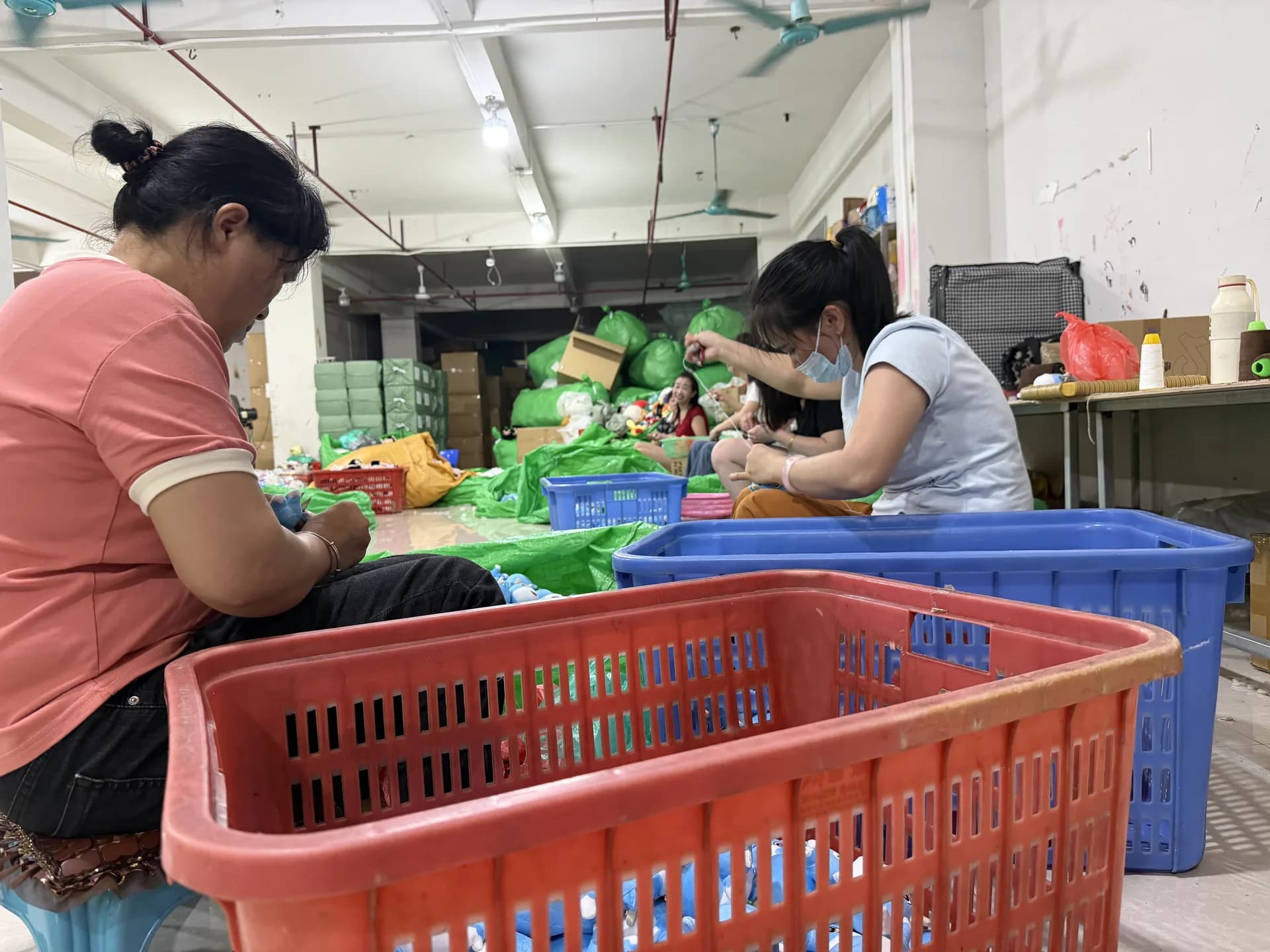
Final note. The right factory for your project isn't the cheapest, isn't the biggest, isn't the one with the most polished website. It's the one whose POC answers your 14 questions like they've heard them before, sends you a real test report when you ask, and gives you a sample that holds up to all 9 tests above. Find that factory and you'll work with them for years.
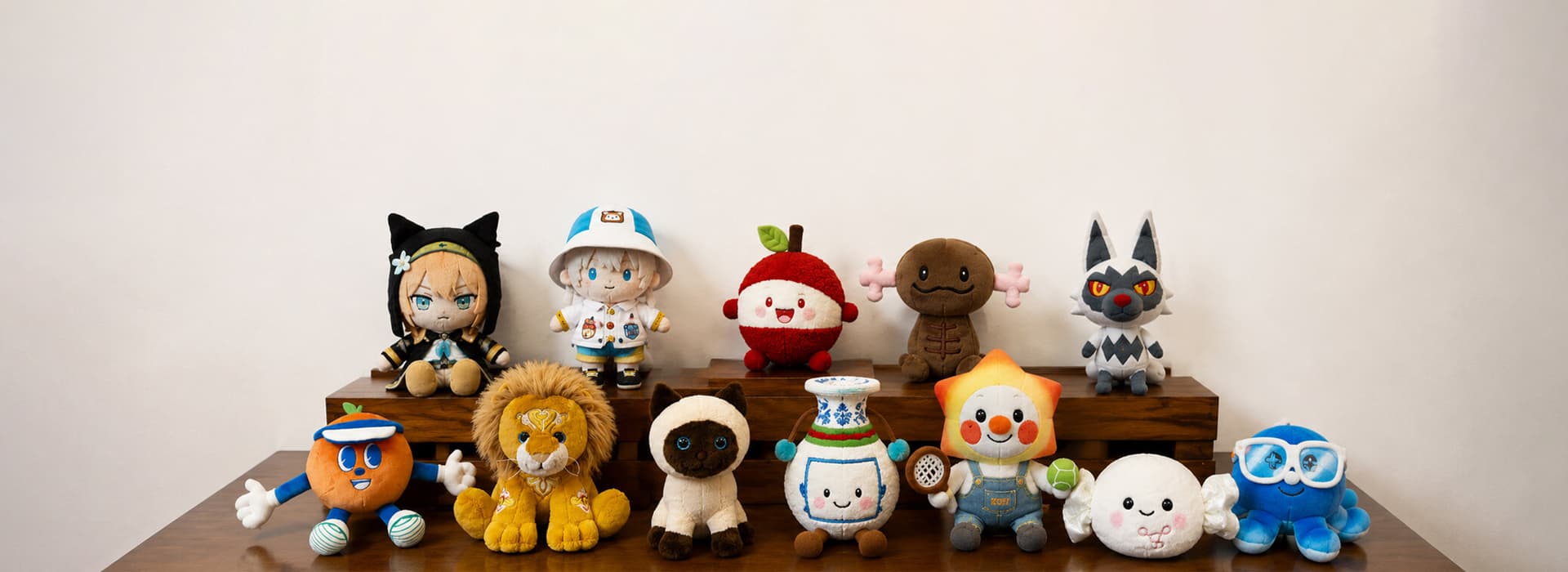
If you want to put CozyPuff on your shortlist, send us a brief at our quote form — we reply within 24 hours, charge a paid sample, and will happily walk you through any of the answers above on a 20-minute call. Browse our portfolio first if you want to see real bulk work shipped to brands.
Written by
Jesse Wong
Founder & Production Lead, CozyPuff · 12+ years in custom plush manufacturing
Twelve years on a Shenzhen plush factory floor — first as a pattern-maker, then running QC for two OEM brands before founding CozyPuff in 2013 around fair pay, low MOQ, and direct-from-factory B2B plush.